What is VESA? The mount standard, explained with numbers
Quick answer
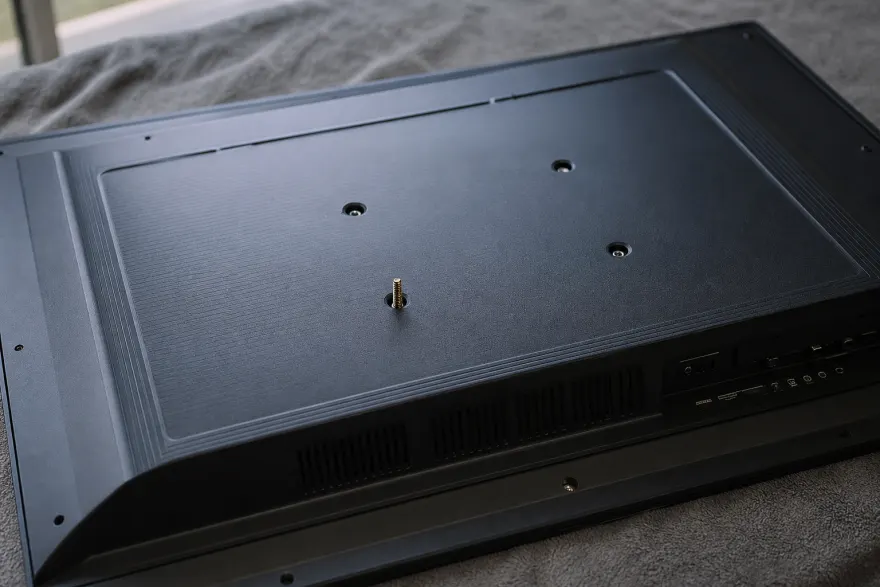
VESA stands for Video Electronics Standards Association; a "VESA mount" uses its Flat Display Mounting Interface (FDMI) — the standardized pattern of 4 threaded holes on the back of a screen, measured center-to-center in millimeters. Sizes run from 75×75 mm on monitors to 800×400 mm on the largest TVs. "VESA compatible" means the holes (or the mount's plate) follow that standard — but the exact numbers, like 400×300 mm, still have to match.
The VESA size chart
The FDMI standard groups patterns into families: MIS-D (75×75 and 100×100 mm, M4 screws — monitors and small TVs), MIS-E (200×100 mm, M4), and MIS-F (200 mm grid increments with M6/M8 screws — most TVs). In practice you'll meet these sizes:
| VESA size (mm) | Typical screens | Screws | In our database |
|---|---|---|---|
| 75×75 | Small monitors | M4 | — |
| 100×100 | Monitors, TVs under 32" | M4 | 1 TV(s) |
| 200×100 | 32–40" TVs | M4/M6 | 2 TV(s) |
| 200×200 | 32–65" TVs | M6/M8 | 19 TV(s) |
| 300×200 / 300×300 | 40–65" TVs (OLEDs favor 300×200) | M6 | 16 / 17 TVs |
| 400×200 / 400×300 | 50–75" TVs | M6/M8 | 2 / 21 TVs |
| 400×400 | 55–85" TVs | M8 | 3 TV(s) |
| 600×400 / 800×400 | 70–98" TVs | M8 | — |
The pattern is always the center-to-center hole spacing, width × height. Same-size screens often use different patterns — the VESA Checker gives the exact value per model.
"VESA compatible TV mount" — what actually has to match
Three numbers, in this order:
- Pattern. The mount's supported range must cover your TV's exact hole spacing. A "VESA compatible" bracket supporting up to 400×400 mm does not fit a 600×400 mm TV.
- Weight. The mount's rating should exceed the TV's stand-free weight by at least 20% — our Will It Fit checker enforces this margin.
- Screws. M4, M6 or M8 thread at the documented length — see the VESA screw size guide. Wrong length is the classic install-day failure.
Where to find your TV's VESA size
- Look it up: every model page here states the pattern with a manufacturer source — start from the brand hubs or search by model number.
- Measure it: two minutes with a tape measure — step-by-step guide.
- Manual: the wall-mounting section of the TV's manual lists pattern and screw spec.
Common misreadings of "VESA"
- "VESA mount" is not one product — it's any bracket following the hole standard; the sizes still differ.
- "VESA certified" on cables (DisplayPort) is a different VESA program entirely — nothing to do with mounting; see the certified DisplayPort cable guide.
- A "VESA TV stand" or pedestal uses the same rear holes as a wall mount — pattern and weight rules apply identically.
Frequently asked questions
What does VESA stand for?
Video Electronics Standards Association — the industry group that standardizes display technology. In everyday use, "VESA" is shorthand for its Flat Display Mounting Interface (FDMI): the standardized square or rectangular pattern of 4 threaded holes on the back of TVs and monitors, e.g. 200×200 or 400×300 mm.
What is a VESA mount?
A wall bracket, arm or stand whose mounting plate matches the FDMI hole pattern on your screen. Because both sides follow the same standard, any VESA mount whose supported range covers your TV's pattern — say 400×300 mm — will bolt on, regardless of who made the TV or the bracket.
What does "VESA compatible" or "VESA compliant" mean?
That the device has FDMI threaded holes (TV/monitor) or a matching plate (mount). It is not a yes/no badge, though: a mount supporting 100×100–400×400 mm is "VESA compatible" yet still won't fit a 600×400 mm TV. Always compare the exact numbers, not the label on the box.
Do all TVs have VESA mounting holes?
Nearly all current US-market TVs from 32 inches up do — every one of the 88 models in our database does. Exceptions exist among unusual form factors and some very cheap small sets, so if you can't find 4 threaded holes (check under plastic plugs), consult the manual before buying any mount.
Is VESA different for monitors and TVs?
Same standard, different ends of the size chart. Monitors mostly use 75×75 or 100×100 mm with M4 screws; TVs run from 100×100 on small sets to 200×200–600×400 mm with M6 or M8 screws as panels grow. That is why monitor arms rarely hold TVs: the plate and the weight rating are both sized for the small end.
Sources
- Per-model patterns cited from manufacturer documentation on each model page.
Next: measure your pattern, check a specific pairing in Will It Fit, or browse VESA 200×200 / 400×300 wall-mount hubs.