Planning guide
How high to mount a TV — height by screen size
Quick answer
Put the center of the screen at seated eye level — about 42 inches from the floor for standard sofa viewing. The screen size changes where the edges land, not the center: a 55-inch panel's bottom edge sits near 29 in, a 75-inch panel's near 24 in. Going higher than ~50 in to the center calls for a tilting or full-motion mount. The chart below computes it per size.
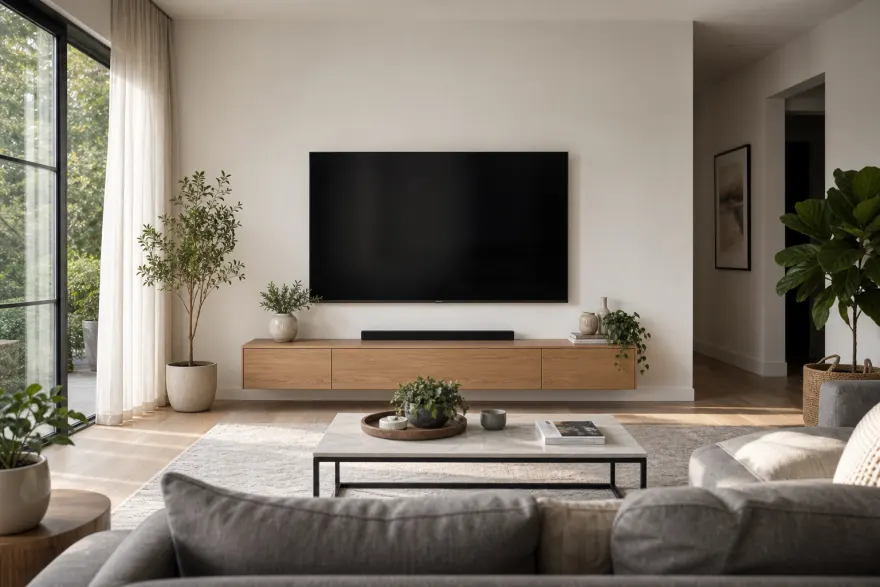
TV height chart: center, top and bottom edge by size
All rows assume the baseline 42-inch center. Panel height comes from 16:9 geometry (height ≈ diagonal × 0.49); comfortable viewing distance is 1.5–2.5× the diagonal.
| Screen | Panel height | Center | Bottom edge | Top edge | Viewing distance |
|---|---|---|---|---|---|
| 43-inch | ~21 in | 42 in | ~31 in | ~53 in | 5.4–9 ft |
| 50-inch | ~25 in | 42 in | ~3 in | ~54 in | 6.3–10.4 ft |
| 55-inch | ~27 in | 42 in | ~29 in | ~55 in | 6.9–11.5 ft |
| 65-inch | ~32 in | 42 in | ~26 in | ~58 in | 8.1–13.5 ft |
| 75-inch | ~37 in | 42 in | ~24 in | ~6 in | 9.4–15.6 ft |
| 85-inch | ~42 in | 42 in | ~21 in | ~63 in | 10.6–17.7 ft |
Screen sizes link to our verified per-size databases — every model there lists its VESA pattern, screw spec and stand-free weight.
The formula, when your room isn't standard
- Measure seated eye height at the main seat: floor to your eyes, relaxed posture. Sofas land at 38–46 in; bar seating at 60+; beds vary wildly.
- That number is your screen-center height. Mark it on the wall.
- Convert to bracket position: most TVs hang with their VESA holes at or slightly above panel center — the exact offset is in the mount's template. Models with bottom-offset holes (flagged on our model pages) hang higher than the bracket suggests, so dry-fit first.
Panel height ≈ diagonal × 0.49. Top edge = center + half the panel height; bottom edge = center − half. A VESA Checker lookup gives the rest of the shopping list for your exact model.
Above eye level? Tilt buys the comfort back
Every 10 inches of extra height adds roughly 5–8° of upward gaze at a 8–10 ft couch distance. Downward tilt (5–15° on typical tilting mounts) re-aims the panel at your eyes, which also cuts reflections from windows and lamps. Above a fireplace, prefer full-motion or pull-down hardware and treat the stud anchoring as non-negotiable — leverage grows with height.
Double-check before drilling
- Mark the screen-center height, then tape the TV's real outline (from the model page's dimensions) on the wall and live with it for a day.
- Confirm the mount's VESA range covers your TV's pattern and its rating beats the stand-free weight by 20% — the Will It Fit checker does both.
- Cables need somewhere to go: plan the outlet or a concealer channel before the bracket goes up, not after.
Frequently asked questions
How high should a 65-inch TV be mounted?
Center the screen at about 42 inches from the floor for seated sofa viewing. A 65-inch panel is roughly 32 inches tall, so the bottom edge lands near 26 inches and the top near 58 inches. Raise the center only if your seating is unusually high, and add downward tilt if you must go above 50 inches.
Is 42 inches to the center a strict rule?
It is a baseline, not a law. The real rule is: screen center at the seated eye level of your main seat. Measure from the floor to your eyes while seated — typically 38 to 46 inches on a standard sofa — and put the center there. Bar stools, reclined seating and beds all move the number.
How high should a TV be in a bedroom?
Higher than in a living room, because you watch reclined. Measure your eye height propped against the headboard and aim the center there — often 50 to 60 inches — and pick a tilting mount (5–15 degrees of downward tilt) so the panel faces you rather than the opposite wall.
Can I mount a TV above a fireplace?
You can, but it costs comfort: the center often ends up 60+ inches high, well above eye level, which strains the neck over a full movie. If the fireplace is the only wall that works, use a full-motion or pull-down mount with generous tilt, verify the manufacturer's operating temperature while the fireplace runs, and keep the mantel heat gap the mount manual requires.
Does mounting height change the mount I should buy?
Yes. At eye level a fixed low-profile mount is fine. Above eye level you want tilt; far above (fireplace) you want full-motion or a pull-down bracket. The bracket must still match your TV's VESA pattern and weight — check your exact model in the database before buying.
Sources
- Panel heights derived from 16:9 screen geometry; per-model dimensions and weights cited on each model page from manufacturer documentation.
- Viewing-distance range follows the common 30–40° field-of-view recommendations used across the industry.
Not sure which bracket style suits that height? Compare them in fixed vs tilting vs full-motion, then verify the pairing in the Will It Fit checker.